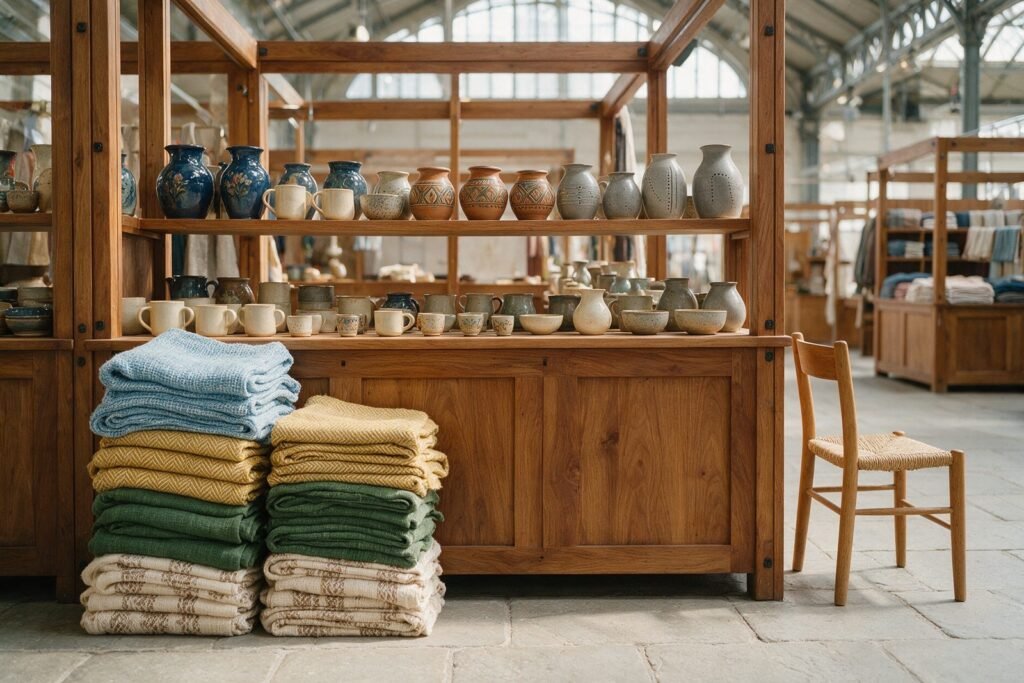
You can walk past a table three times before you notice what is wrong with it. The work is good. The price is fair. And nobody stops.
It is almost never the pieces. It is the table.
Nothing is at eye level
Everything is lying flat, arranged like a drawer. From standing height, a bowl on a tablecloth is a circle. A bowl raised on a small block, or turned on its side, or hung on the wall behind, becomes a shape you want to touch. The fair is not a shop: people are standing, coats on, hands full, moving. Your table has to work at that height.
There is no price
No price means one of two things to a visitor: it is expensive, or they have to ask. Both cost you the shy ones — and the shy ones are often the ones who came to buy. A small card in front of each group is enough. It also filters the people who were never going to buy, which gives you back your voice for the ones who will.
The seller is sitting behind the table
Sitting is honest — fairs are long — but a seated seller behind a table is a wall. Standing at the side, or stepping out in front when someone slows down, changes the geometry of the conversation. You are no longer defending a stall. You are showing something.
The table is too full
An overcrowded table asks the visitor to do the work of choosing. Five good pieces, spaced, with room around them, sell better than twenty pressed together. What you leave in the bag is not lost. It is the thing you bring out when someone says “I am looking for something smaller”.
One thing you can try tomorrow
Pick the three pieces you would save if the hall caught fire. Put those at the front, at eye level, with a price. Move everything else back. Then stand beside the table, not behind it, for the first hour.
You will not sell more because the table is prettier. You will sell more because people can finally see what you made.
If you sell at fairs, the practical side — a page that stays current between them — is at Ring & Ship.